The Bibliography
Topic DONE!
Thesis
Cluster ideas
Preliminary Outline with three main points, two sub points each
Now that you have a debatable argument and have begun to develop it, you need
to start thinking about what you're going to use to support that argument.
You'll be expected to do two things with this assignment: 1) Begin research, 2)
Begin the Works Cited page in MLA format. Mr. Janes neither can nor will do this
for you. You are expected to begin working autonomously now as you will need to
for the remainder of the Research Paper unit and in your upcoming post-secondary
life.
Do not take it personally when if you ask something that
is clearly answered here that you're told to USE YOUR RESOURCES.
Do not say you can't
- again, that translates as Clearly
Are
Not
Trying. Ask
questions NOW, during the presentation of this material.
Annotated Bibliographies
Click here for your sample
Your assignment’s guidelines:
Using the source criteria for your research paper,
you will create an annotated bibliography, following the explanation and
example as a template. You need to do three (3) things:
- Summarize each
source as explained and discussed in class.
- Assess each source
as explained and discussed in class.
- Reflect on
each source as explained and discussed in class.
- ALSO -
- Each entry will be in
correct MLA
format.
- The final draft will be saved as
works cited to your
portfolio by the due date.
- You will cite and annotate a minimum
(more OK) of four (4)
sources.
Again, Summarize, Assess, Reflect on FOUR
(4) sources. Make sure you follow MLA format.
Then upload the finalized document as
works cited via
Moodle
Definition
A bibliography is a list of sources (books, journals, websites, periodicals,
etc.) one has used for researching a topic. A bibliography usually just includes
the bibliographic information (i.e., the author, title, publisher, etc.).
An annotation is a summary and/or evaluation. Therefore, an annotated
bibliography includes a summary and/or evaluation of each of the sources.
Depending on your project or the assignment, your annotations may do one or more
of the following:
Summarize: Some annotations merely summarize the source. What are
the main arguments? What is the point of this book or article? What topics are
covered? If someone asked what this article/book is about, what would you say?
The length of your annotations will determine how detailed your summary is.
You do not necessarily need to read an entire book to
summarize it, but you will be expected to spend adequate time to
understand its basics. If you simply skim a resource, you will not be able to
summarize it, let alone assess or reflect upon it. If you do not put the
expected energy into each resource, it will be obvious in your work and
will be graded according to what you earned.
For more help, see this handout on
paraphrasing sources.
Assess: After summarizing a source, it may be helpful to evaluate
it. Is it a useful source? How does it compare with other sources in your
bibliography? Is the information reliable? Is it this source biased or
objective? What is the goal of this source?
For more help, see
evaluating resources.
Reflect: Once you've summarized and assessed a source, you need to
ask how it fits into your research. Was this source helpful to you? How does
it help you shape your argument? How can you use this source in your research
project? Has it changed how you think about your topic?
Purpose
To learn about your topic: Writing an annotated bibliography is
excellent preparation for a research project. Just collecting sources for a
bibliography is useful, but when you have to write annotations for each
source, you're forced to read each source more carefully. You begin to read
more critically instead of just collecting information.
To help you formulate a thesis: Every good research paper is an
argument. The purpose of research is to state and support a thesis. So a very
important part of research is developing a thesis that is debatable,
interesting, and current. Writing an annotated bibliography can help you gain
a good perspective on what is being said about your topic. By reading and
responding to a variety of sources on a topic, you'll start to see what the
issues are, what people are arguing about, and you'll then be able to develop
your own point of view.
To help other researchers: Extensive and scholarly annotated
bibliographies are sometimes published. They provide a comprehensive overview
of everything that has been and is being said about that topic. You may not
ever get your annotated bibliography published, but as a researcher, you might
want to look for one that has been published about your topic.
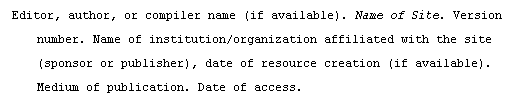
The bibliographic information: See this page for WHAT YOU ARE
EXPECTED TO KNOW AND SHOW:
http://owl.english.purdue.edu/owl/resource/747/05/ This will be discussed
in class and the expectation is you will USE THIS RESOURCE when creating your
Works Cited page.
Or...
Do you prefer to use an online tool like EasyBib?
Great! Use any tool you'd like and copy/paste the results to a Word document
as save AS EXPECTED. But remember, you will still be responsible for completing this
assignment and the research paper itself AS EXPECTED. Keep this in mind now
and for college and beyond as sometimes we think we have it figured out but
yet have not bothered to FOLLOW DIRECTIONS and for that, no educator will
apologize to you for your disregard.
The annotations: The annotations for each source are written in
paragraph form. The lengths of the annotations can vary significantly from a
couple of sentences to a couple of pages. The length will depend on the
purpose. If you're just writing summaries of your sources, the annotations may
not be very long. However, if you are writing an extensive analysis of each
source, you'll need more space.
Example
Sample:
| Sample (What you write -
Do not write the numbers - They're there to guide you.)
1) Heading
2) Title: An Annotated Bibliography
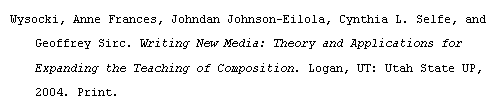
3) Citation #1 (in MLA format)
4) Annotation #1 (summary, assessment and reflection)
5) Citation/Annotation #2
6) Citation/Annotation #3
7) Citation/Annotation #4 |
(1) Your name
Mr. Janes
English 12
Date
(2) Stem Cell
Research: An Annotated Bibliography (working title - can still change over
time)
3)
(4 - Summary) This is the
annotation of the above source. In this example, I am following MLA
guidelines for the bibliographic information listed above. If I were really
writing an annotation for this source, I would now be offering a brief
summary of what this book says about stem cell research.
(4 -
Assessment) After a brief
summary, it would be appropriate to assess this source and offer
any criticisms of it that you might have. Does it seem like a reliable and current source?
Why? Is the research biased or objective? Are the facts well documented?
Who is the author? Is she qualified in this subject? Is this source
scholarly, popular, some of both?
(4 -
Reflection) The length of your
annotation will depend on the assignment or on the purpose of your
annotated bibliography. After summarizing and assessing, you can now reflect
on this source. How does it fit into your research? Is this a helpful
resource? Too scholarly? Not scholarly enough? Too general/specific? Since
"stem cell research" is a very broad topic, has this source
helped you to narrow your topic?
(5)
Summarize it here.
Assess it here.
Reflect on it here.
(6)

Summarize it
here.
Assess it here.
Reflect on it here.
(7)
Summarize it
here.
Assess it here.
Reflect on it here.
|
See this handout for the
sample entry above and more information about the why and how of an annotated bibliography.
Helpful links
Source:
http://owl.english.purdue.edu/handouts/general/gl_annotatedbib.html
Some external resources used with permission:
Purdue University Online Writing Lab (OWL)
|